Overview
I joined the Aramaki Lab after taking Multi-Messenger Astrophysics with Professor Aramaki.
The lab needed a mechanical engineer, and I've been contributing to the GRAMS (Gamma-Ray and
AntiMatter Survey) experiment since, working on both mechanical design and data analysis.
Background
Dark matter constitutes ~27% of the universe but has never been directly detected. The GRAMS
experiment searches for dark matter signatures using a Liquid Argon Time Projection Chamber
(LArTPC). Cosmic ray muons bombard Earth at ~1 per cm²/min and can pass through the TPC,
mimicking the signals GRAMS is designed to detect. Without a reliable veto, these background
events contaminate the data.
The Challenge
Before the planned flight in May 2025, the team needed to conduct routine tests to ensure
reliable data acquisition, environmental control, and proper heat transfer. This required
immersing the TPC in a liquid argon chamber at the lab — but no mounting solution existed
to do so safely.
Design & Solution
As the team's mechanical engineer, I designed and 3D printed a component that could interface
securely with the flange of the liquid argon chamber, avoid interference with surrounding
tubes and sensitive components, and hold the delicate detector with enough stability to
prevent positional shifts that could compromise data quality.
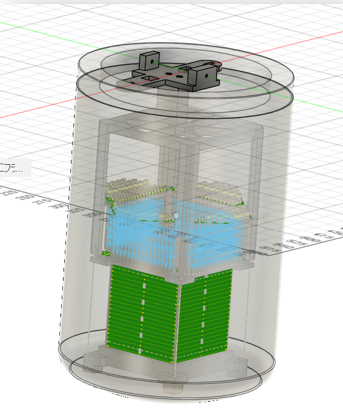
CAD model of the TPC holder
Process & Iteration
The design required many iterations — little existing CAD was available to reference, and
significant trial and error was needed to achieve correct fits and tolerances. I took
ownership of weekly prototyping, gaining hands-on experience with rigorous 3D printer
maintenance and troubleshooting.
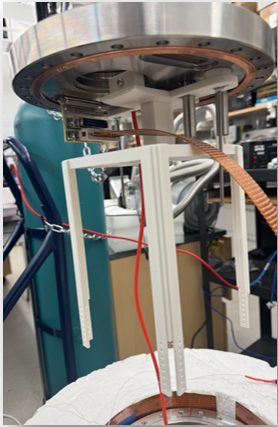
The implemented TPC holder in use at the Aramaki Lab — still in active use today
Detector Construction
Constructed plastic scintillator paddles wrapped in Teflon and sealed for light-tightness.
SiPMs coupled to each paddle convert scintillation photons to voltage pulses.
Mechanical Jig (v2)
Engineered a fully 3D-printed modular mounting system to suspend dual scintillator arrays
at a fixed 1-meter height above the LArTPC. The design comprises a split retainer base,
gusseted support arms, and adjustable collar clamps interfacing with the chamber flange,
enabling precise and repeatable detector alignment while remaining fully adjustable for
laboratory use.
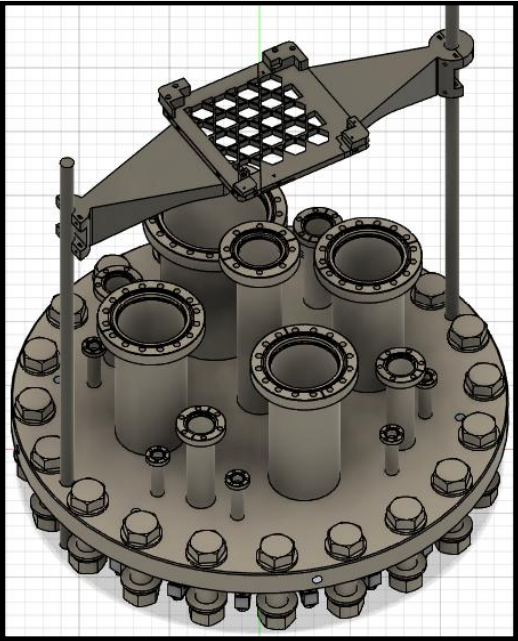
3D-printed modular mounting system for dual scintillator arrays
Signal Optimization
Identified poor signal-to-noise ratio caused by ground loops. Implemented copper mesh
grounding scheme and unified cable shielding. Rise times improved from ~100 ns to 5 ns.
Coincidence Detection and Analysis
When scintillation paddles on opposite sides of the detector fire at the same time, we can
identify through-going muons. From 19,118 events, 429 muon candidates were identified at
±200 ns coincidence window, with 40 events within ±10 ns.
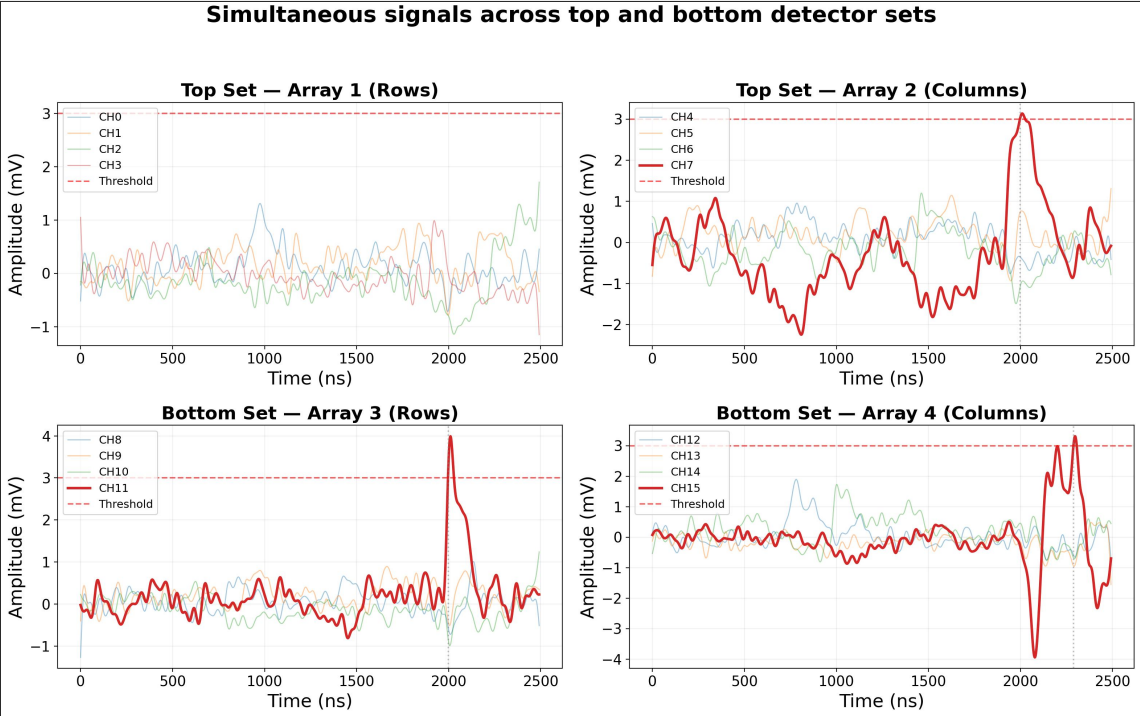
Muon candidate event showing simultaneous signals on 3 of 4 arrays with Δt = 0 ns
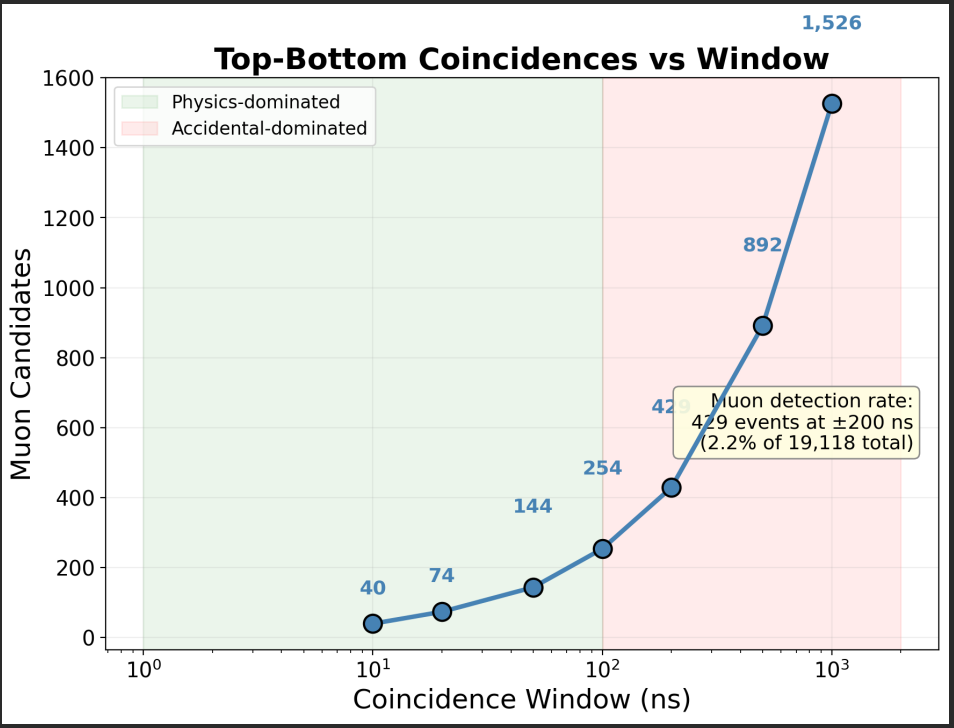
Coincidence count scaling with window size, demonstrating separation of true muon signals from accidental background
Python Data Analysis
Analyzed 1M+ cosmic muon events using Python, achieving Landau distribution fitting with
MPV at 7.1 mV. Top detector crosshatch shows uniform spatial response (247–363 coincidences
per tile).
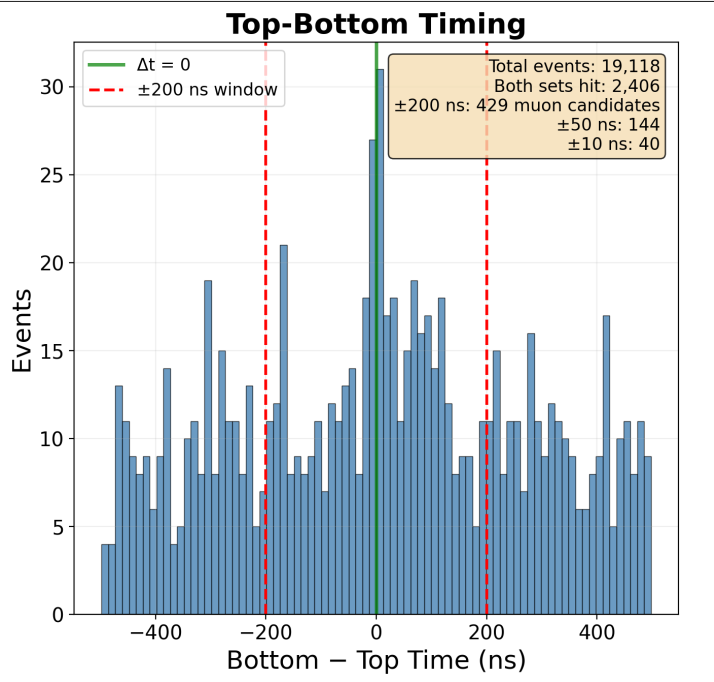
Top-bottom timing distribution histogram
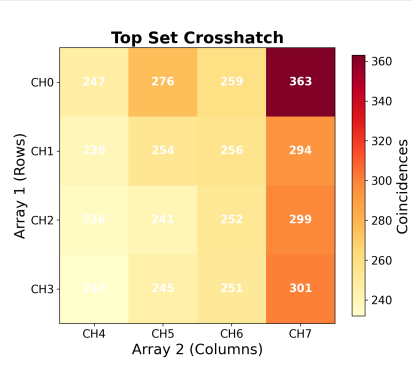
Top detector crosshatch — coincidences per tile
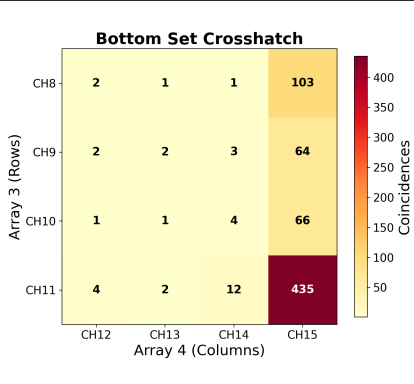
Bottom detector crosshatch — coincidences per tile
Next Steps
Set per-channel trigger thresholds to normalize rates across all pixels. Detailed bias
voltage study per paddle. Integrate veto system with GRAMS LArTPC for lab-scale testing.
Skills & Technologies
Autodesk Inventor
3D Printing (FDM)
Rapid Prototyping
Python
Data Analysis
Instrumentation Development
Scintillator Detector Design
SiPM Technology
Tolerance Analysis
Lab Equipment Design